
How is the target score calculated in cricket, and why does it sometimes change halfway through a chase? This guide explains where the target on the scoreboard comes from. It covers a normal limited-overs match, a game shortened before it starts, a rain break in the middle of a match, and the fourth innings of a Test. You’ll also see which targets you can work out yourself and which one you can’t.
Quick Answer
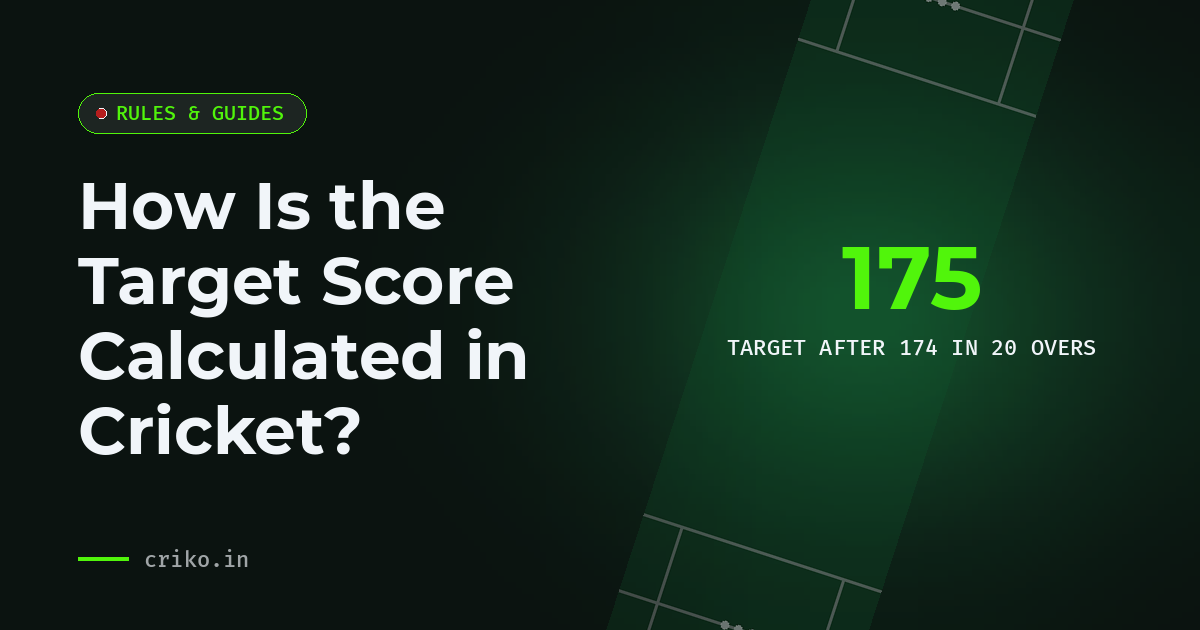
In a limited-overs match the target is the first-innings total plus one run, because the chasing side has to score more runs than the opposition to win. If the side batting first makes 174, the target is 175, and 174 only ties. If overs are cut before the match starts, both sides get the same reduced overs and the rule doesn’t change. If overs are lost once play has started, the officials set a revised target, which in international and IPL cricket comes from the Duckworth-Lewis-Stern (DLS) method.
Why the Target Is One More Than the Total
The MCC Laws of Cricket (Law 16, The Result) say a side wins by scoring more runs than the opposing side has scored in its completed innings. The ICC’s T20I playing conditions on the result say the same thing and add that equal scores in completed innings are a tie, whatever the wickets.
So the scoreboard shows two numbers in a chase:
| First-innings total | Scores level at | Target to win |
|---|---|---|
| 174 | 174 | 175 |
| 243 | 243 | 244 |
| 118 | 118 | 119 |
Wickets don’t come into the target. A side that finishes on 174 for 9 sets the same target as one that’s 174 all out.
Formula
Target = First-innings total + 1
At the start of a chase, the run rate needed to reach it is:
Required run rate at the start = Target ÷ Overs available
Overs available are the overs the chasing side is allowed, not the overs the first side actually batted. Once the chase is under way, use runs still needed (target − current score) over the balls left.
Step-by-Step Calculation
A team bats first in a T20 and makes 174 for 6 in its 20 overs.
- Scores level at: 174.
- Target: 174 + 1 = 175.
- Overs available for the chase: 20.
- Rate needed from ball one: 175 ÷ 20 = 8.75 runs per over.
That 8.75 is the figure to compare against as the chase goes on. A side scoring at 8.75 or better will get there as long as it keeps wickets in hand. That’s a reading of the numbers, not a prediction.
When the side batting first is all out early
Here the overs trap shows up. Suppose a team is bowled out for 243 in 47.3 overs of a 50-over match.
The target is still the total plus one: 244. Being bowled out early doesn’t shorten the chase. Under the ICC’s ODI playing conditions on innings, the side batting second still gets its full 50 overs in an uninterrupted match. So the rate needed from ball one is 244 ÷ 50 = 4.88 runs per over.
People often go wrong when comparing it with the first side’s scoring rate. 47.3 overs means 47 overs and 3 balls, which is 285 legal balls (47 × 6 + 3). That’s 47.50 overs in decimal terms, so the first side scored at 243 ÷ 47.50 = 5.12 runs per over. Dividing by 47.3 as if it were a decimal gives 5.14, which is slightly wrong.
The point: the first side’s run rate (5.12) and the chasing side’s required rate (4.88) are different numbers, because one is spread over 47.3 overs and the other over 50.
Targets in Reduced-Overs Matches
“Reduced overs” covers two situations that work very differently.
Overs cut before the match starts
If rain or a late start shortens the game before a ball is bowled, both sides are given the same reduced number of overs. The ICC’s T20I playing conditions on innings say that a revision should give both teams the chance to bat for the same number of overs whenever possible.
Nothing about the target changes. Say a match is cut to 12 overs a side and the first team makes 118. The target is 119, and the chasing side needs 9.92 runs per over across its 12 overs. Both teams knew their resources from the start, so the plain “total plus one” rule is still fair.
Overs lost after play has started
This is where a calculator can’t help you. If overs are lost during the first innings, or during the chase, the two sides end up with different resources. For example, the first team may have batted knowing it had 20 overs while the second team gets only 15.
In international cricket, the ICC’s playing conditions say the side batting second is then set a revised target using the Duckworth-Lewis-Stern method. The IPL uses DLS too. DLS looks at the overs and the wickets each side had left when play stopped. That’s why the revised target isn’t simply the first-innings total scaled down to the new overs.
Two details from the ICC conditions are worth knowing:
- A revised target is always a whole number, and one run fewer is a tie.
- There has to be enough cricket for a result. A T20I needs at least 5 overs for the side batting second, and an ODI needs at least 20, unless a result comes sooner.
Criko doesn’t calculate DLS targets, and you shouldn’t estimate one by hand. The professional DLS calculation isn’t public, and the official target comes from the match officials. Once they’ve announced it, though, you can work with it like any other target.
Example: A Real Revised Target (MI v GT, IPL 2025)
In IPL 2025, Mumbai Indians made 155 for 8 in 20 overs against Gujarat Titans at the Wankhede Stadium on 6 May 2025.
- Original target: 155 + 1 = 156, or 7.80 runs per over over 20 overs.
- Rain stopped play twice during the chase. At the second stoppage, after 18 overs, Gujarat were 132 for 6.
- Revised target: the officials set Gujarat 147 from 19 overs under DLS. From the start of a 19-over chase that’s 7.74 per over, close to the original rate, but the target and the overs both moved.
- What was left: 147 − 132 = 15 runs from the last 6 balls, a required rate of 15.00.
Gujarat won by three wickets off the final ball. The original target of 156 was never reached, and it didn’t need to be. Once a revised target is set, it’s the only one that counts. Here, too, the takeaway comes from reading the numbers: the revision cut the target by 9 runs but also took away an over, so the chase didn’t become much easier.
The Target in a Test Match
In a two-innings match, Law 16 compares total runs across both completed innings. The fourth-innings target is:
Target = (opponent’s two innings) − (your first innings) + 1
For example, Team A makes 350 and 240, a total of 590. Team B made 410 in its first innings. Team B needs 590 − 410 = 180 to level the match, so its target is 181. There are no overs limits in a Test, so there’s no required run rate in the limited-overs sense, only the time left in the match.
Important Points
- The match ends the moment the target is reached. Law 16 says that as soon as a result is reached, the match is over. In a T20I in Visakhapatnam in November 2023, India needed one run off the last ball. The bowler overstepped, and the no-ball’s penalty run completed the chase. Rinku Singh’s six off that delivery wasn’t added to the score.
- Extras count towards the target. Wides, no-balls, byes and leg byes all add to the chasing side’s total.
- Use the overs the chasing side has, not the overs the first side used. That’s the 47.3-overs trap above.
- A shortened match is not the same as an interrupted one. Overs cut before the start, with both sides equal: total plus one. Overs lost after play began: a revised target from the officials.
- Local matches set their own rules. Most club and corporate games don’t use DLS. If you organise one, agree on your rain rule and write it down before the tournament starts. The likely arguments are about this, not about the formula.
Frequently Asked Questions
How is the target score calculated in cricket?
Add one run to the first-innings total. A side batting second has to score more runs than the opposition to win, so if the first team makes 174, the target is 175. Reaching 174 only ties the match.
Does the target change if the team batting first is bowled out early?
No. The target is still the total plus one, and in an uninterrupted ODI the chasing side still gets its full 50 overs. Being bowled out for 243 in 47.3 overs sets a target of 244 from 50 overs.
How is the target set when a match is reduced before it starts?
Both teams get the same reduced overs, and the target is still the first-innings total plus one. In a 12-over-a-side match where the first team makes 118, the target is 119.
What is a revised target in cricket?
It’s a new target set by the officials when overs are lost after play has started. In international and IPL cricket it comes from the Duckworth-Lewis-Stern method, which accounts for both the overs and the wickets each side had left. The revised target is always a whole number.
Can I calculate a DLS target myself?
Not reliably. The professional DLS calculation isn’t public, so use the figure the officials announce. Once you have it, you can enter it in the target score calculator’s revised target option to see the rate needed.
How do you work out the target in the fourth innings of a Test?
Add the opponent’s two innings totals, subtract your own first-innings total, and add one. If the opponent made 350 and 240 and you made 410, the target is 590 − 410 + 1 = 181.
What happens if the chasing side finishes level with the target minus one?
The scores are equal, so the match is a tie. Wickets lost don’t decide it. Under the ICC’s T20I playing conditions, a tied match goes to a Super Over.
Related Criko Tools
- Target score calculator: enter the first-innings total and overs to get the target and the rate needed. Use “Enter a revised target” for an official DLS target.
- Required run rate calculator: once the chase has started, it tracks runs needed from the balls left.
- Overs to balls converter: turns notation like 47.3 into 285 balls.
Related Cricket Guides
Conclusion
The target is the first-innings total plus one run. That holds for a full match and for one shortened before it starts. Only when overs are lost after play has begun does it change, and then the revised DLS target from the officials replaces it. Check which situation you’re in, use the chasing side’s overs, and the rest is simple arithmetic.